
'India needs to be cautious that its differences with Pakistan do not obstruct SCO's functioning,' says Sana Hashmi.

US Secretary of State Antony Blinken said that the United States is calling on all nations not to have major weapons transactions with Russia. He made these marks after the conclusion of the 2+2 Ministerial Dialogue between the defence and foreign ministers of India and the United States.

In a veiled reference to China's aggressive military behaviour, Defence Minister Rajnath Singh on Thursday said exercising self-restraint in the conduct of activities and avoiding actions that may further complicate situation will go a long way in bringing sustained regional peace.

Any miscalculation and miscommunication are fraught with the risk of a major catastrophe, warns Rup Narayan Das.

In a secret-ballot voting in the 193-member UN General Assembly on that race, Pakistan secured 169 votes.

US admiral's suggestion for a revival of a strategic maritime quadrilateral with Japan, Australia and India leaves China livid, says Rajeev Sharma.
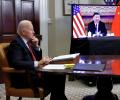
Washington is signalling to Delhi that it can rely on American support in any great game vis-a-vis China. Delhi shouldn't fall into the trap, argues Ambassador M K Bhadrakumar.
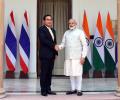
Thailand's importance to India's Act East policy is too significant to be overlooked.

"We value our partnership with India, and we've been increasing it and doing a lot more, over time. They have the same security challenge, primary security challenger that we do, and it's real on their northern border," Admiral John Christopher Aquilino, commander of United States Indo-Pacific Command, told members of the House Armed Services Committee during a hearing on Indo-Pacific National Security Challenges.

'Wang Yi said the border issue is important and we should stay committed to peacefully addressing it through consultation and coordination.'

In the past, India strongly rejected references made to Jammu and Kashmir in a previous joint statement by Pakistan and China.

Recognising the threat posed by outfits like the Al Qaeda, Lashkar-e-Tayiba and the Dawood Ibrahim network, India and the United States have agreed to deepen cooperation in fighting terrorism and asked Pakistan to bring to justice the 2008 Mumbai attack perpetrators.

Talmiz Ahmad is a former Indian ambassador to Saudi Arabia, Oman and the UAE. In an interview with Aditi Phadnis, he says the disequilibrium in Iraq will continue to prevail. Ahmad also says there are indications that the US is now anxious to avoid intervening militarily in West Asia, and that this is the appropriate moment for Asia to assume responsibility for its own security. Edited excerpts:
Kurt Campbell, the White House Asia Coordinator, said that in his view India is the most important bilateral relationship for the United States in the 21st century.

'Any fear or apprehension that this dialogue is aimed towards China, that is mistaken.'
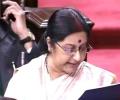
The external affairs minister said PM Modi had discussed with his Pakistani counterpart of re-engaging with each other."

External Affairs Minister Sushma Swaraj is not attending the Heart of Asia ministerial meeting.

With the situation in Ladakh tense and no resolution in sight the trigger to take the India-US relationship to a transformational one is already there, observes Lieutenant General Syed Ata Hasnain (retd).

'We are confident that the US manufacturing industry will be able to take advantage of the US-India Investment Initiative to effectively support our goals of assisting in the development of three Indian cities -- Ajmer, Vishakhapatnam and Allahabad -- where the United States will be the lead partner,' Senators Warner and Cornyn told Obama.
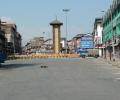
India has been maintaining that China has no locus standi in commenting on Jammu and Kashmir.

However, there is no official word on whether there will be any interaction between Modi and Pakistan President Mamnoon Hussain, who is scheduled to attend the meeting in China.
Against the backdrop of growing Chinese assertion in the Asia-Pacific region, India on Thursday said it supports the "freedom of navigation" in international waters noting that any disputes or differences in the region must be resolved diplomatically.

Aziz said all issues, including Kashmir, would be part of the peace talks under the agreed formula for the fresh re-engagement with India.
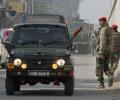
Condemning the terror attack on the Pathankot air force base, China said it may have been launched "intentionally" to disrupt the momentum in Indo-Pak ties.

"We often thought of terrorism as a peripheral problem for this region. The barbaric terrorist strikes in Paris, Ankara, Beirut, Mali and on the Russian aircraft is a stark reminder that its shadow stretches across our societies and our world, both in recruitment and choice of targets," Modi said in his remarks at the East Asia Summit.

India's full membership of the grouping would extend its reach to the Central Asian region in whose peace and stability it is a major stakeholder, says Sana Hashmi.

The Obama administration's point man for South Asia, United States Assistant Secretary of State Robert Blake, tells rediff.com/India Abroad's Aziz Haniffa in this exclusive interview that Secretary of State Hillary Clinton who co-chairs the second US-India Strategic Dialogue with External Affairs Minister S M Krishna on Tuesday
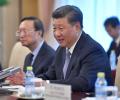
Following the Chinese president's comments on Kashmir, India in a quick response asserted that it is not for other countries to comment on "internal affairs of India".

The launching ceremony for the first warship was held at the Hudong Zhonghua Shipyard in Shanghai on Sunday. Pakistan-China defence ties turn a new chapter with the launch of the first ship of Type-054 class frigate, Pakistan's state-run APP news agency reported.

Pakistan is once again becoming a frontline State in big-power rivalry. But this time around, Pakistan stands to gain out of its geography, observes Ambassador M K Bhadrakumar.
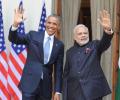
The US wants its trade with India to grow multi-fold, Assistant Secretary of State for South and Central Asia Nisha Desai Biswal told lawmakers.
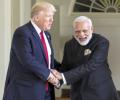
Now, the NDAA needs to be passed by the Senate before it can be sent to the White House for the US President Donald Trump to sign into law.

After his wide-ranging talks with Modi on the second and final day of his India visit, Johnson said the new defence and security partnership will enable India to strengthen its domestic defence industry as well as help the two countries protect vital shared interests in the Indo-Pacific.
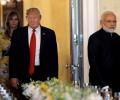
The White House said the two leaders also pledged to continue working together to enhance security and prosperity in the Indo-Pacific region.

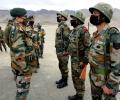
As per the sources, the discussions between the two sides include pulling back tanks and armoured vehicles from their present positions, and some development in this regard is likely to take place in the next few days.
In an exclusive interview to Rediff.com, US Assistant Secretary of State Robert O Blake speaks about President Obama's trip to India, the recent US-India Strategic Dialogue and the fate of the nuclear liability bill.
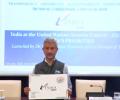
If elected, it would be India's eighth term on the UN Security Council and this two-year tenure will start in January 2021.
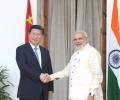
With the continuing stand-off in Ladakh casting a shadow over the Sino-India talks, Prime Minister Narendra Modi on Thursday raised 'serious concerns' over the repeated incidents along the border and sought an early settlement of the boundary question.
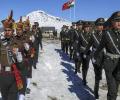
In a joint statement, the two armies said it was agreed to earnestly implement the important consensus reached by the leaders of the two countries and ensure that the frontline troops exercise restraint and avoid misunderstanding and miscalculation.
